

[Dec-2021] Exam PCAP-31-03: New Brain Dump Professional - PrepAwayTest
Free PCAP-31-03 Exam Dumps to Improve Exam Score
Topics of PCAP - Certified Associate in Python Programming (PCAP-31-03) Exam
The syllabus for the PCAP-31-03 dumps is listed below in detail of each section and their topics:
1. Control and Evaluations (25%)
Objectives covered by this section:
- simple strings: constructing, assigning, indexing, slicing comparing, immutability
- accuracy of floating-point numbers
- simple lists: constructing vectors, indexing, and slicing, the len() function
- the pass instruction
- conditional statements: if, if-else, if-elif, if-elif-else
- controlling loop execution: break, continue
- Boolean operators: not and or
- relational operators (== != > >= < <= ), building complex Boolean expressions
- basic input and output: input(), print(), int(), float(), str() functions
- numeric operators: * / % // + â
- string operators: * +
- operators: unary and binary, priorities and binding
- literals: Boolean, integer, floating-point numbers, scientific notation, strings
- bitwise operators: ~ & ^ | « »
- formatting print() output with end= and sep= arguments
- building loops: while, for, range(), in, iterating through sequences
- assignments and shortcut operators
- expanding loops: while-else, for-else, nesting loops, and conditional statements
- basic concepts: interpreting and the interpreter, compilation and the compiler, language elements, lexis, syntax and semantics, Python keywords, instructions, indenting
2. Data Aggregates (25%)
Objectives covered by this section:
- tuples vs. lists: similarities and differences, lists inside tuples and tuples inside lists
- lists in detail: indexing, slicing, basic methods (append(), insert(), index()) and functions (len(), sorted(), etc.), del instruction, iterating lists with the for loop, initializing, in and not in operators, list comprehension, copying and cloning
- lists in lists: matrices and cubes
- strings in detail: ASCII, UNICODE, UTF-8, immutability, escaping using the \ character, quotes and apostrophes inside strings, multiline strings, copying vs. cloning, advanced slicing, string vs. string, string vs. non-string, basic string methods (upper(), lower(), isxxx(), capitalize(), split(), join(), etc.) and functions (len(), chr(), ord()), escape characters
- tuples: indexing, slicing, building, immutability
- dictionaries: building, indexing, adding and removing keys, iterating through dictionaries as well as their keys and values, checking key existence, keys(), items(), and values() methods
3. Functions and Modules (25%)
Objectives covered by this section:
- return and yield keywords, returning results, the None keyword, recursion
- converting generator objects into lists using the list() function
- lambda functions, defining and using
- pyc file creation and usage
- Python hashbangs, using multiline strings as module documentation
- name scopes, name hiding (shadowing), the global keyword
- import directives, qualifying entities with module names, initializing modules
- defining and invoking your functions and generators
- constructing and distributing packages, packages vs. directories, the role of the init.py file
- the if operator
- hiding module entities
- map(), filter(), reduce(), reversed(), sorted() functions and the sort() method
- parameters vs. arguments, positional keyword and mixed argument passing, default parameter values
- writing and using modules, the name variable
4. Classes, Objects, and Exceptions (25%)
Objectives covered by this section:
- single inheritance vs. multiple inheritances
- hasattr(), type(), issubclass(), isinstance(), super() functions
- assertions
- writing and using constructors
- exceptions hierarchy, assigning more than one exception to one except branch
- invoking methods, passing and using the self-argument/parameter
- introspection: dict, name, module, bases properties, examining class/object structure
- inheritance and overriding, finding class/object components
- the role of the str method
- the init method
- adding your exceptions to an existing hierarchy
- using predefined exceptions and defining your ones
- class methods: defining and using the self-parameter meaning and usage
- name mangling
- input/output basics: opening files with the open() function, stream objects, binary vs. text files, newline character translation, reading and writing files, byte array objects
- the anatomy of an exception object
- read(), readinto(), readline(), write(), close() methods
- defining your classes, superclasses, subclasses, inheritance, searching for missing class components, creating objects
- the try-except-else-finally block, the raise statement, the except-as variant
- class attributes: class variables and instance variables, defining, adding, and removing attributes, explicit constructor invocation
NEW QUESTION 37
What can you deduce from the following statement? (Select two answers)
str = open('file.txt', "rt")
- A. the opened file cannot be written with the use of the str variable
- B. str is a string read in from the file named file.txt
- C. a newlina character translation will be performed during the reads
- D. if file. txt does not exist, it will be created
Answer: A,B
NEW QUESTION 38
A Python module named pymod, py contains a function named pyfun ( ).
Which of the following snippets will let you invoke the function? (Select two answers)
- A. Import pyfun from pymod
Pyfun ( ) - B. From pymod import pyfun
Pyfun ( ) - C. Import pymod
Pymod. Pyfun ( ) - D. From pymod import '
Pymod.pyfun ( )
Answer: B,C
NEW QUESTION 39
Which of the following snippets will execute without raising any unhandled exceptions? (Select answers) A)
B)
C)
D)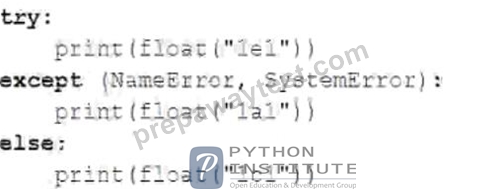
- A. Option D
- B. Option A
- C. Option C
- D. Option B
Answer: A,C,D
NEW QUESTION 40
Assuming that the code below has been placed inside a file named code.py and executed successfully, which of the following expressions evaluate to True? (Select two answers)
- A. str(Object) == 'Object'
- B. len(ClassB.__bases__) == 1
- C. ClassA. _module_ == 'ClassA'
- D. _name == _main_'
Answer: B
NEW QUESTION 41
What would you use instead of XXX if you want to check whether a certain ' key' exists in a dictionary called diet? (Select two answers) II if XXX:
print("Key exists")
- A. diet['key'] != None
- B. diet.exists('key')
- C. 'key' in diet.keys()
- D. 'key' in diet
Answer: A,C
NEW QUESTION 42
What is the expected behavior of the following code?
- A. it outputs nothing
- B. it raises an exception
- C. it outputs False
- D. it outputs True
Answer: D
NEW QUESTION 43
What is the expected behavior of the following code?
- A. it outputs 2
- B. it outputs 1
- C. the code is erroneous and it will not execute
- D. it outputs 3
Answer: D
NEW QUESTION 44
Which of the following lines of code will work flawlessly when put independently inside the add_new () method in order to make the snippet's output equal to [0, 1, 1] ? (Select two answers)
- A. self .put self.get () [-1])
- B. put self.store(1])
- C. self put stire(1])
- D. self .put (self.store[1])
Answer: C,D
NEW QUESTION 45
What is true about Object-Oriented Programming in Python? (Select two answers)
- A. the same class can be used many times to build a number of objects
- B. if a real-life object can be described with a set of adjectives, they may reflect a Python object method
- C. each object of the same class can have a different set of methods
- D. a subclass is usually more specialized than its superclass
Answer: A,B
NEW QUESTION 46
What can you deduce from the following statement0 (Select two answers) str = open('file.txt', "rt")
- A. str is a string read in from the file named file. txt
- B. the opened file cannot be written with the use of the str variable
- C. a newlina character translation will be performed during the reads
- D. if file. txt does not exist, it will be created
Answer: B,C
NEW QUESTION 47
With regards to the directory structure below, select the proper forms of the directives in order to import module_a. (Select two answers)
- A. import module_a from pypack
- B. import pypack.module_a
- C. import module_a
- D. from pypack import module_a
Answer: B,D
NEW QUESTION 48
Assuming that the code below has been executed successfully, which of the following expressions evaluate to True? (Select two answers)
- A. 'prop' in Class.__diet
- B. 'var1 in Class, diet
- C. 'var' in Object.__diet__
- D. len(Object.__diet__) == 1
Answer: D
NEW QUESTION 49
What is the expected behavior of the following code?
- A. it outputs list assignment index out of range
- B. it outputs error
- C. the code is erroneous and it will not execute
- D. it outputs <class ' IndexError' >
Answer: A
NEW QUESTION 50
What is the output of the following piece of code?
- A. ant bat came1
- B. antbatcame1
- C. ant'bat'came1
- D. ant"bat"came1
Answer: D
Explanation: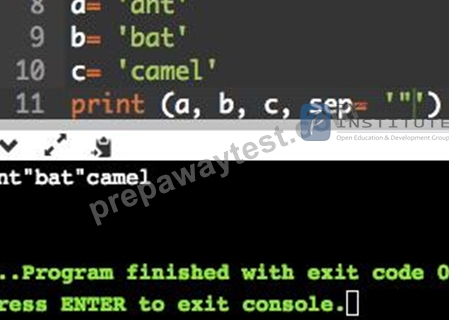
NEW QUESTION 51
Assuming that the following piece of code has been executed successfully, which of the expressions evaluate to True? (Choose two.)
- A. isinstance (obj_b,A)
- B. A.VarA == 1
- C. B.VarA == 1
- D. obj_a is obj_aa
Answer: A,D
NEW QUESTION 52
An operator able to perform bitwise shifts is coded as (select two answers)
- A. ++
- B. >>
- C. - -
- D. <<
Answer: B,D
NEW QUESTION 53
What is true about Python packages? (Select two answers)
- A. the sys.path variable is a list of strings
- B. a code designed to initialize a package's state should be placed inside a file named init.py
- C. a package contents can be stored and distributed as an mp3 file
- D. _pycache_is a folder that stores semi-completed Python modules
Answer: B,D
NEW QUESTION 54
Which of the following lines of code will work flawlessly when put independently inside the add_new () method in order to make the snippet's output equal to [0, 1, 21 ? (Select two answers)
- A. self.queue.append(self.queue[+1]
- B. queue.append(self.get last () + 1)
- C. self.queue.append(self.get last() +1)
- D. self.queue.append(get_Iast() + 1)
Answer: C
NEW QUESTION 55
Which of the following statement are true? (Select two answers)
- A. the second open ( ) argument describes the open mode and defaults to 'w'
- B. closing an open file is performed by the closefile ( ) function
- C. if open ( ) 's second argument is 'r' the file must exist or open will fail
- D. if open ( )'s second argument is 'w' and the invocation succeeds, the previous file's content is lost
Answer: C,D
NEW QUESTION 56
The simplest possible class definition in Python can be expressed as:
- A. class X:
pass - B. class X:
return - C. class X:
- D. class X: {}
Answer: C
NEW QUESTION 57
What is the expected behavior of the following code?
- A. it outputs 3
- B. it raises an exception
- C. it outputs 'None'
- D. it outputs 0
Answer: D
NEW QUESTION 58
......
Powerful PCAP-31-03 PDF Dumps for PCAP-31-03 Questions: https://www.prepawaytest.com/Python-Institute/PCAP-31-03-practice-exam-dumps.html
2021 Realistic PCAP-31-03 Dumps Exam Tips Test Pdf Exam Material: https://drive.google.com/open?id=13GSgTA9Qdh6Hx1smotAfjBA3PIod7Jay