

Cisco 300-515 Exam Info and Free Practice Test | PrepAwayTest
Pass Cisco 300-515 Premium Files Test Engine pdf - Free Dumps Collection
Cisco 300-515 certification exam is an essential credential for IT professionals who work with service provider VPN services. Earning this certification demonstrates a high level of expertise and experience in implementing and managing VPN solutions in a service provider environment. Implementing Cisco Service Provider VPN Services certification can also lead to career advancement opportunities and increased earning potential.
The Cisco exam called 300-515 SPVI concerns the implementation of Cisco VPN services for the Service Provider. It regards matters like Layer 2, Layer3, and IPv6. When one passes it, he or she will be awarded the CCNP Service Provider certificate.
NEW QUESTION # 45
What is the primary function of a VRF on a router?
- A. It enables the router to provide faster switching through the network by using labels to identify the input and output interfaces for neighbor routers.
- B. It enables the router to support multiple separate routing tables, which allows the device to handle overlapping IP addresses.
- C. It enables a router to configure VLANs locally, which provides segregation between networks.
- D. It enables a router to run BGP and a distance vector routing protocol at the same time, which allows it to serve as a VPN endpoint between remote sites.
Answer: B
NEW QUESTION # 46
While troubleshooting EoMPLS configuration problems, which three parameters should an engineer match between the two ends of the pseudowire configurations? (Choose three.)
- A. Xconnect group name
- B. pseudowire ID
- C. control word usage
- D. MTU size
- E. EFP subinterface number
- F. VLAN name
Answer: B,C,D
Explanation:
Reference:
https://www.cisco.com/c/en/us/support/docs/multiprotocol-label-switching-mpls/mpls/213238-mpls- l2vpn-pseudowire.html
NEW QUESTION # 47
Refer to the exhibit. Router 1 is a route reflector client within a service provider core.
PE1 cannot see VPNv4 routes received from the ASBR.
PE1 only has an iBGP relationship with Router 1.
Which action resolves this issue?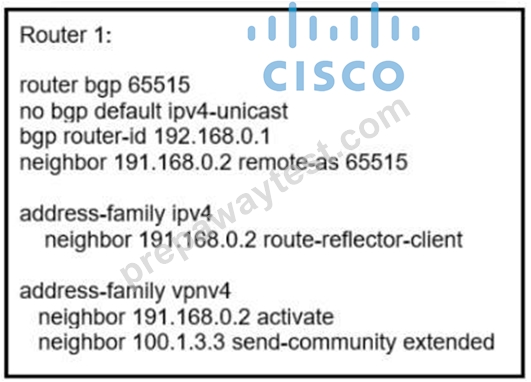
- A. Enable BGP default ipv4-unicast
- B. Configure Router 1 as a route reflector for PE1 under the VPNv4 address family.
- C. Activate PE1 as a neighbor under the IPv4 address family.
- D. Configure PE1 to have an eBGP relationship with Router 1.
Answer: B
NEW QUESTION # 48
An ISP provides a major client MPLS VPN for managed services. The MPLS engineering team needs to use the advanced VPN feature of selective VRF import so that only specific prefixes are present in the required VPNs.
Which aspect of this feature must the team consider?
- A. A route is imported into the VRF only when at least one RT that is attached to the route matches one RT that is configured in the VRF and the route is permitted by the import route map.
- B. The routers that are imported in the VRF can be BGP and IGP routes, so other match conditions in the route map, besides communities, can be used.
- C. A route must pass the import route map first and then the route target import filter.
- D. The import-map command is applied under the PE interface that connects to the CE router.
Answer: A
Explanation:
Reference:
https://www.ccexpert.us/mpls/configuring-selective-vrf-import.html
NEW QUESTION # 49
With Layer 3 MPLS VPN implementations on Cisco IOS XR PE routers, an interface is assigned to a VRF using the vrf command in which configuration mode?
- A. RP/0/RP0/CPU0:PE(config-if)#
- B. RP/0/RP0/CPU0:PE(config-vrf)#
- C. RP/0/RP0/CPU0:PE(config-bgp)#
- D. RP/0/RP0/CPU0:PE(config-bgp-af)#
Answer: A
Explanation:
Section: Layer 3 VPNs
Explanation/Reference: https://www.cisco.com/c/en/us/td/docs/ios_xr_sw/iosxr_r3-7/mpls/configuration/guide/ gc37v3.html
NEW QUESTION # 50
Which is the primary function of a MPLS L3 VPN route target?
- A. It imports and exports identified routes into selected VRFs.
- B. It uniquely identifies NLRIs that have the same numeric value.
- C. It imports the external routes it identifies into VRFs that support Internet traffic
- D. It supports QoS by classifying traffic by file type when it applies MPLS EXP bits to each packet.
Answer: A
NEW QUESTION # 51
While troubleshooting an AToM L2VPN service, a network consultant notices that the AC Layer 2 encapsulations are different. Which action should the consultant take in order to make the MPLS L2VPN work?
- A. interworking IP configuration on the last PE router before label disposition
- B. nonrouted interworking setup to properly translate only the Layer 2 information from the AC
- C. interworking IP configuration on both the AC terminations on the PEs
- D. tag-rewrite on the ingress and egress PE router
Answer: C
Explanation:
Reference:
https://www.cisco.com/c/en/us/td/docs/ios-xml/ios/mp_l2_vpns/configuration/xe-16-11/mp-l2-vpns- xe-16-11-book/l2vpn-interworking.html
NEW QUESTION # 52
You try to configure MPLS VPN VRF Selection based on a source IP address on an interface that has VRF configured, but you receive an error.
Which action must you take to correct the problem?
- A. Add the IP address to the VRF table.
- B. Change the source IP address.
- C. Remove the VRF from the interface.
- D. Configure static routes for the VRF.
Answer: C
Explanation:
Reference:
https://www.cisco.com/c/en/us/td/docs/ios/12_0s/feature/guide/vrfselec.html
NEW QUESTION # 53
Which condition must be met before an environment can support CSC?
- A. The CSC-CE must support OSPFv3.
- B. The CSC-PE and CSC-CE must each be able to ping an interface in its respective global routing table.
- C. The CSC-PE and CSC-CE devices must be able to send labels to one another using BGP.
- D. The CSC-PE and the CSC-CE must support IPv6.
Answer: C
NEW QUESTION # 54
Which two statements describe primary differences between MPLS Layer 2 and Layer 3 VPNs?
(Choose two.)
- A. Layer 2 VPNs use AToM, but Layer 3 VPNs use MPLS/BGP.
- B. Layer 2 VPNs use BGP, but Layer 3 VPNs use VPLS.
- C. Layer 2 VPNs use IPsec tunneling, but Layer 3 VPNs use pseudowires to provide tunneling.
- D. Layer 2 VPNs use IPsec tunneling, but Layer 3 VPNs use L2TPv3 tunneling.
- E. Layer 2 VPNs use L2TPv3 tunneling, but Layer 3 VPNs use GRE tunneling.
Answer: A,E
NEW QUESTION # 55
Drag and drop the EVPN components from the left onto the correct planes on the right.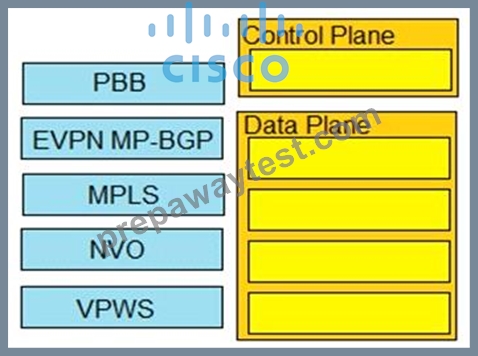
Answer:
Explanation: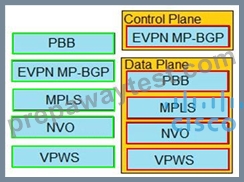
Reference:
https://www.cisco.com/c/dam/m/en_us/network-intelligence/service-provider/digital-transformation/ knowledge-network-webinars/pdfs/0420-epn-ckn.pdf slide 8
NEW QUESTION # 56
Refer to the exhibit.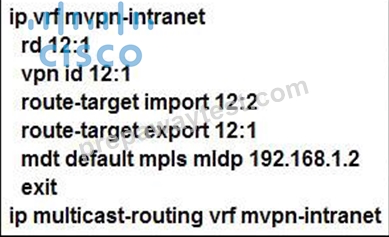
Which statement about this configuration is true?
- A. Router 1 has statically defined thresholds for data MDT.
- B. Router 1 will accept multicast routes with a route-target of 12:1.
- C. 192.168.1.2 must be reachable by all routers participating in the mvpn-intranet MVRF.
- D. The MVRF must be configured on each router on the customer and service provider networks.
Answer: B
NEW QUESTION # 57
An ISP provides a major client MPLS VPN for managed services. The MPLS engineering team needs to use the advanced VPN feature of selective VRF import so that only specific prefixes are present in the required VPNs.
Which aspect of this feature must the team consider?
- A. A route is imported into the VRF only when at least one RT that is attached to the route matches one RT that is configured in the VRF and the route is permitted by the import route map.
- B. The routers that are imported in the VRF can be BGP and IGP routes, so other match conditions in the route map, besides communities, can be used.
- C. A route must pass the import route map first and then the route target import filter.
- D. The import-map command is applied under the PE interface that connects to the CE router.
Answer: A
Explanation:
Section: VPN Architecture
Explanation/Reference: https://www.ccexpert.us/mpls/configuring-selective-vrf-import.html
NEW QUESTION # 58
Refer to the exhibit.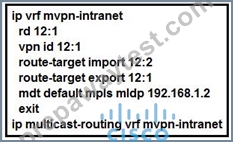
Which statement about this configuration is true?
- A. Router 1 has statically defined thresholds for data MDT.
- B. Router 1 will accept multicast routes with a route-target of 12:1.
- C. 192.168.1.2 must be reachable by all routers participating in the mvpn-intranet MVRF.
- D. The MVRF must be configured on each router on the customer and service provider networks.
Answer: B
NEW QUESTION # 59
Which BGP feature causes to replace the AS number of originating router with the AS number of the sending router?
- A. route reflectors
- B. AS override
- C. route dampening
- D. confederations
Answer: B
Explanation:
Reference: https://community.cisco.com/t5/networking-documents/understanding-bgp-as-override-feature/ta- p/3111967
NEW QUESTION # 60
Which Layer 2 VPN technology is implemented over an IP core network without the need for MPLS?
- A. VPWS
- B. L2TPv3
- C. AToM
- D. VPLS
Answer: B
NEW QUESTION # 61
How does Layer 3 VPN traffic traverse an ISP network?
- A. Devices on the network use LSAs to share routes between P routers in the network.
- B. Devices on the network use MPLS labels to move VPN traffic through the network.
- C. Devices on the network use GRE tunnels to move traffic between VRFs.
- D. Devices on the network use MPLS labels to share VPN routes between P routers in the network.
Answer: B
NEW QUESTION # 62
Refer to the exhibit. Which statement about this configuration is true?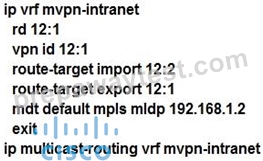
- A. Router 1 has statically defined thresholds for data MDT.
- B. Router 1 will accept multicast routes with a route-target of 12:1.
- C. 192.168.1.2 must be reachable by all routers participating in the mvpn-intranet MVRF.
- D. The MVRF must be configured on each router on the customer and service provider networks.
Answer: B
NEW QUESTION # 63
Which mechanism reduces the network flooding caused by host ARP learning behavior?
- A. BPDU guard
- B. storm control
- C. ARP suppression
- D. root guard
Answer: C
Explanation:
Reference:
https://www.cisco.com/c/en/us/products/collateral/switches/nexus-7000-series-switches/white- paper-c11-735015.html
NEW QUESTION # 64
Refer to the exhibit.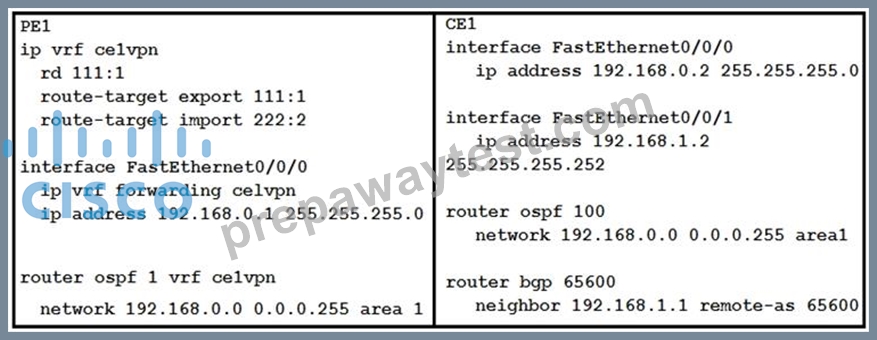
If the two devices are operating normally, which two conclusions can you draw from this configuration?
(Choose two.)
- A. PE1 labels the routes it learns from CE1 with the route-target 111:1 and shares them with its VPNv4 peers.
- B. CE1 must use OSPF to establish a neighbor relationship with PE1.
- C. The PE-CE routes between the devices are being exchanged by OSPF
- D. CE1 is supporting CSC.
- E. PE1 labels the routes it learns from CE1 with the route-target 222:2 and shares them with its VPNv4 peers.
Answer: B,C
NEW QUESTION # 65
......
Cisco 300-515 certification exam is an excellent way for professionals to advance their careers and demonstrate their expertise in implementing VPN services in a service provider network. Implementing Cisco Service Provider VPN Services certification is recognized worldwide and is highly respected in the networking industry. 300-515 exam is designed to be challenging, but with the right preparation and study materials, candidates can increase their chances of passing the exam and earning the certification.
Updated Official licence for 300-515 Certified by 300-515 Dumps PDF: https://www.prepawaytest.com/Cisco/300-515-practice-exam-dumps.html