

Oracle 1Z0-082 Deluxe Study Guide with Online Test Engine
1Z0-082 dumps review - Professional Quiz Study Materials
What is the duration, language, and format of Oracle 1z0-082: Oracle Database Administration I Exam
- Certification Validity period : 3 years.
- This exam consists of 90 questions.
- Section 2: 45%
- Section 3: 33%
- There is a time limit of 140 minutes for the exam.
- Passing score:
- This exam is offered in only English.
- The type of questions is Multiple Choice Questions.
- Section 1: 60%
Oracle database certifications require periodic recertification. To hold your certification inactive condition, you must update to the new edition within 1 year of Oracle’s credential withdrawal.
Introduction to Oracle 1z0-082: Oracle Database Adminstration 1 Exam
Oracle Database 12c: RAC and Grid Infrastructure Administration Exam assess the abilities of the Database Administrators and System Administrators who have at least 1 year of experience in RAC and Grid Infrastructure. The candidates should have the ability to install, manage, tracking, tuning and restoring RAC databases, cluster, and Oracle Automatic Storage Management (ASM). They should have a good understanding of the architectures of the ASM, Clusterware, and Oracle RAC databases. They should also know how to install, setup, backup, and recovery monitoring and tuning of these components.
Oracle Real Application Clusters (RAC) in database computing is a choice for Oracle Database software developed by Oracle Corporation, it provides clustering software and high availability in Oracle database environments. With the Enterprise Version, Oracle Corporation includes RAC, provided the nodes are clustered using Oracle Clusterware. Oracle RAC allows several machines when accessing a single database, to run Oracle RDBMS software simultaneously, offering to cluster.
The Oracle Grid Infrastructure for an independent server is the Oracle software that offers system support for a database including the file system, volume management, and automation of the restart process. If you want to utilize the Oracle restart or Oracle Automatic Storage Management (ASM) services, you have to install Oracle grid infrastructure before installing Oracle Database.
Who should take the Oracle 1z0-082: Oracle Database Administration I Exam
This course is designed for Database Administrators and Database production Systems Administrators.
NEW QUESTION 19
Which two statements are true about UNDO and REDO? (Choose two.)
- A. DML modifies Oracle database objects and generates UNDO and REDO
- B. DML modifies Oracle database objects and only generates UNDO
- C. The generation of REDO generates UNDO
- D. DML modifies Oracle database objects and only generates REDO
- E. The generation of UNDO generates REDO
Answer: A,E
Explanation:
https://www.experts-exchange.com/articles/13880/UNDO-AND-REDO-IN-ORACLE.html
NEW QUESTION 20
Which three statements are true about Oracle synonyms? (Choose three.)
- A. A synonym cannot be created for a PL/SQL package
- B. A SEQUENCE can have a synonym
- C. Any user can drop a PUBLIC synonym
- D. A synonym created by one user can refer to an object belonging to another user
- E. A synonym can be available to all users
Answer: B,D,E
Explanation:
Reference:
https://docs.oracle.com/cd/B19306_01/server.102/b14200/statements_7001.htm
NEW QUESTION 21
Examine the description of the EMPLOYEES table:
Which query is valid?
- A. SELECT dept_id, join_date, SUM(salary) FROM employees GROUP BY dept_id;
- B. SELECT dept_id, join_date, SUM(salary) FROM employees GROUP BY dept_id, join_date;
- C. SELECT dept_id, MAX(AVG(salary)) FROM employees GROUP BY dept_id;
- D. SELECT dept_id, AVG(MAX(salary)) FROM employees GROUP BY dept_id;
Answer: A
NEW QUESTION 22
Which statement is true about aggregate functions?
- A. Aggregate functions can be used in any clause of a SELECT statement
- B. The MAX and MIN functions can be used on columns with character data types
- C. Aggregate functions can be nested to any number of levels
- D. The AVG function implicitly converts NULLS to zero
Answer: B
NEW QUESTION 23
Which two statements are true about the ORDER BY clause when used with a SQL statement containing a SET operator such as UNION? (Choose two.)
- A. Column positions must be used in the ORDER BY clause
- B. The first column in the first SELECT of the compound query with the UNION operator is used by default to sort output in the absence of an ORDER BY clause
- C. Each SELECT statement in the compound query must have its own ORDER BY clause
- D. Only column names from the first SELECT statement in the compound query are recognized
- E. Each SELECT statement in the compound query can have its own ORDER BY clause
Answer: D,E
NEW QUESTION 24
You execute this command:
Sufficient storage is available in filesystem /u01.
Which two statements are true about the BIG_TBS tablespace? (Choose two.)
- A. It must be bigger than the largest SMALLFILE tablespace
- B. Additional data files may not be added
- C. AUTOEXTEND is possible for the datafile
- D. It will be a dictionary-managed tablespace by default
- E. It will always have a 32K blocksize
Answer: B,C
NEW QUESTION 25
Which two tasks can you perform using DBCA for databases? (Choose two.)
- A. Configure incremental backups for a new database
- B. Register a new database with an available Enterprise Manager Management server
- C. Enable flashback database for an existing database
- D. Change the standard block size of an existing database
- E. Configure a nonstandard block size for a new database
Answer: B,D
NEW QUESTION 26
Which three activities are recorded in the database alert log? (Choose three.)
- A. session logins and logouts
- B. non-default database parameters
- C. deadlock errors
- D. block corruption errors
- E. Data Definition Language (DDL) statements
Answer: B,C,D
Explanation:
https://docs.oracle.com/cd/B28359_01/server.111/b28310/monitoring001.htm#ADMIN11247
NEW QUESTION 27
You execute this command:
CREATE SMALLFILE TABLESPACE sales
DATAFILE '/u01/app/oracle/sales01.dbf
SIZE 5G
SEGMENT SPACE MANAGEMENT AUTO;
Which two statements are true about the SALES tablespace? (Choose two.)
- A. It must be smaller than the smallest BIGFILE tablespace
- B. It is a locally managed tablespace
- C. Free space is managed using freelists
- D. Any data files added to the tablespace must have a size of 5 gigabytes
- E. It uses the database default blocksize
Answer: B,E
NEW QUESTION 28
Which three statements are true about a self-join? (Choose three.)
- A. The query must use two different aliases for the table
- B. It must be an inner join
- C. The ON clause can be used
- D. It must be an equi join
- E. It can be an outer join
- F. The ON clause must be used
Answer: A,B,C
NEW QUESTION 29
You have been tasked to create a table for a banking application.
One of the columns must meet three requirements:
1. Be stored in a format supporting date arithmetic without using conversion functions
2. Store a loan period of up to 10 years
3. Be used for calculating interest for the number of days the loan remains unpaid Which data type should you use?
- A. TIMESTAMP WITH TIMEZONE
- B. TIMESTAMP
- C. INTERVAL YEAR TO MONTH
- D. INTERVAL DAY TO SECOND
- E. TIMESTAMP WITH LOCAL TIMEZONE
Answer: D
NEW QUESTION 30
Examine this SQL statement:
SELECT cust_id, cust_last_name "Last Name"
FROM customers
WHERE country_id = 10
UNION
SELECT cust_id CUST_NO, cust_last_name
FROM customers
WHERE country_id = 30
Identify three ORDER BY clauses, any one of which can complete the query successfully.
(Choose three.)
- A. ORDER BY CUST_NO
- B. ORDER BY 2, cust_id
- C. ORDER BY "Last Name"
- D. ORDER BY "CUST_NO"
- E. ORDER BY 2, 1
Answer: B,C,E
NEW QUESTION 31
Which statement is true about aggregate functions?
- A. Aggregate functions can be nested to any number of levels
- B. Aggregate functions can be used in any clause of a SELECT statement
- C. The MAX and MIN functions can be used on columns with character data types
- D. The AVG function implicitly converts NULLS to zero
Answer: A
NEW QUESTION 32
You want to write a query that prompts for two column names and the WHERE condition each time it is executed in a session but only prompts for the table name the first time it is executed.
The variables used in your query are never undefined in your session.
Which query can be used?
SELECT &&col1, &&col2
- A. FROM &table
WHERE &&condition = &&cond;
SELECT &col1, &col2 - B. FROM &&table
WHERE &condition;
SELECT &col1, &col2 - C. FROM &table
WHERE '&&condition' = '&cond';
SELECT &&col1, &&col2 - D. FROM &table
WHERE &&condition; - E. FROM "&table"
WHERE &condition;
SELECT '&&col1', '&&col2'
Answer: B
NEW QUESTION 33
Which two statements are true about the PMON background process? (Choose two.)
- A. It frees resources held by abnormally terminated processes
- B. It registers database services with all local and remote listeners known to the database instance
- C. It kills sessions that exceed idle time
- D. It records checkpoint information in the control file
- E. It frees unused temporary segments
Answer: A,B
Explanation:
Explanation/Reference: https://docs.oracle.com/cd/B19306_01/server.102/b14220/process.htm
NEW QUESTION 34
You execute this command:
During the export operation, you detach from the job by using CTRL+C and then execute this command:
Export> STOP_JOB=immediate
Are you sure you wish to stop the job ([yes]/no): yes
Which two statements are true about the job? (Choose two.)
- A. It continues to run in the background
- B. It is paused and can be resumed
- C. It terminates
- D. You can reattach to it and monitor it
- E. You can no longer monitor it
Answer: C,E
Explanation:
https://blog.oracle48.nl/killing-and-resuming-datapump-expdp-and-impdp-jobs/
NEW QUESTION 35
A database is configured to use automatic undo management with temporary undo enabled.
An UPDATE is executed on a temporary table.
Where is the UNDO stored?
- A. in the undo tablespace
- B. in the SGA
- C. in the PGA
- D. in the temporary tablespace
- E. in the SYSAUX tablespace
Answer: A
Explanation:
https://docs.oracle.com/database/121/ADMIN/undo.htm#ADMIN11478 (16.7)
NEW QUESTION 36
The SALES_Q1 and USERS tablespaces exist in one of your databases and TEMP is a temporary tablespace.
Segment creation is not deferred.
You execute this command: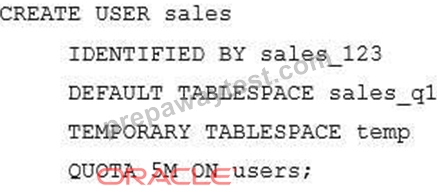
Which three statements must be true so that the SALES user can create tables in SALES_Q1? (Choose three.)
- A. The sales user must have a quota on the SALES_Q1 tablespace to hold all the rows to be inserted into any table in their schema
- B. The sales user must have a quota on the TEMP tablespace
- C. The sales user must have a quota on the SALES_Q1 tablespace to hold the initial extends of all tables they plan to create in their schema
- D. The sales user must have been granted the CREATE SESSION privilege
- E. The sales user must have their quota on the users tablespace removed
- F. The sales user must have been granted the CREATE TABLE privilege
Answer: C,E,F
NEW QUESTION 37
Which three statements are true about undo segments and the use of undo by transactions in an Oracle database instance? (Choose three.)
- A. A single transaction may use multiple undo segments simultaneously
- B. Undo segments can wrap around to the first extent when a transaction fills the last extend of the undo segment
- C. Undo segments must be stored in a BIGFILE tablespace
- D. Undo segments can extend when a transaction fills the last extent of the undo segment
- E. Undo segments must be stored in a SMALLFILE tablespace
- F. Undo segments have a minimum of three extents
- G. An undo segment may be used by multiple transactions simultaneously
Answer: D,E,G
NEW QUESTION 38
Your database instance is started with a PFILE.
Examine these parameters:
You want to increase the size of the buffer cache.
Free memory is available to increase the size of the buffer cache.
You execute the command:
SQL> ALTER SYSTEM SET DB_CACHE_SIZE=1024M;
What is the outcome?
- A. It fails because the SCOPE clause is missing
- B. The value is changed for the current instance and in the PFILE
- C. The value is changed only in the PFILE and takes effect at the next instance startup
- D. Change is applied to the current instance, but does not persist after instance restart
Answer: D
Explanation:
https://docs.oracle.com/database/121/SQLRF/statements_2017.htm#SQLRF00902
NEW QUESTION 39
In one of your databases, user KING is:
1. Not a DBA user
2. An operating system (OS) user
Examine this command and its output:
What must you do so that KING is authenticated by the OS when connecting to the database instance?
- A. Grant DBA to KING
- B. Have the OS administrator add KING to the OSDBA group
- C. Set OS_AUTHENT_PREFIX to OPS$
- D. Unset REMOTE_LOGIN_PASSWORDFILE
- E. Alter user KING to be IDENTIFIED EXTERNALLY
Answer: C
Explanation:
https://oracle-base.com/articles/misc/os-authentication
NEW QUESTION 40
View the Exhibits and examine the structure of the COSTS and PROMOTIONS tables.
You want to display PROD_IDS whose promotion cost is less than the highest cost PROD_ID in a promotion time interval.
Examine this SQL statement:
Exhibit 1.
Exhibit 2.
What will be the result?
- A. It gives an error because the GROUP BY clause is not valid
- B. It executes successfully and gives the required result
- C. It executes successfully but does not give the required result
- D. It gives an error because the ALL keyword is not valid
Answer: B
NEW QUESTION 41
In one of your databases, you create a user, HR, and then execute this command:
GRANT CREATE SESSION TO hr WITH ADMIN OPTION;
Which three actions can HR perform? (Choose three.)
- A. Revoke the CREATE SESSION privilege from other users
- B. Grant the CREATE SESSION privilege with ADMIN OPTION to other users
- C. Execute DML statements in the HR schema
- D. Revoke the CREATE SESSION privilege from user HR
- E. Log in to the database instance
- F. Execute DDL statements in the HR schema
Answer: A,B,F
Explanation:
https://docs.oracle.com/cd/B28359_01/network.111/b28531/authorization.htm#DBSEG224
NEW QUESTION 42
Which two are true about the roles? (Choose two.)
- A. All privileges and roles granted to a user are enabled by default when the user logs in.
- B. The SET ROLE statement enables as well as disables roles in a session.
- C. The SET ROLE statement can be used once per session.
- D. A role must be disabled before it can be revoked from a user.
- E. The ALTER USER statement must be used to set specific default roles for a user.
Answer: A,B
NEW QUESTION 43
......
Exam Questions Answers Braindumps 1Z0-082 Exam Dumps PDF Questions: https://www.prepawaytest.com/Oracle/1Z0-082-practice-exam-dumps.html
1Z0-082 Test Prep Training Practice Exam Questions Practice Tests: https://drive.google.com/open?id=1tI-qmqp8Ee8ew96Q1UAeoGALw7cVfxTr