

Achieve The Utmost Performance In CCDAK Exam Pass Guaranteed
Achive your Success with Latest Confluent CCDAK Exam
The CCDAK exam is a hands-on assessment that tests the candidate's ability to design, develop, and deploy Kafka-based applications using different programming languages, such as Java, Scala, and Python. CCDAK exam covers a wide range of topics, including Kafka architecture, data serialization and deserialization, producer and consumer APIs, stream processing, and Kafka Connect. CCDAK exam also evaluates the candidate's ability to troubleshoot common Kafka issues and optimize Kafka performance.
The CCDAK Certification Exam covers a wide range of topics related to Kafka and Confluent's platform. This includes topics such as Kafka architecture, Kafka APIs, Kafka configuration, Kafka security, Confluent Schema Registry, and Confluent Kafka Connect. Developers who pass the CCDAK Certification Exam have demonstrated their ability to work with Kafka and Confluent's platform at a high level.
NEW QUESTION # 104
Select the Kafka Streams joins that are always windowed joins.
- A. KStream-GlobalKTable
- B. KTable-KTable join
- C. KStream-KTable join
- D. KStream-KStream join
Answer: D
Explanation:
Seehttps://docs.confluent.io/current/streams/developer-guide/dsl-api.html#joining
NEW QUESTION # 105
There are 3 producers writing to a topic with 5 partitions. There are 5 consumers consuming from the topic.
How many Controllers will be present in the cluster?
- A. 0
- B. 1
- C. 2
- D. 3
Answer: D
Explanation:
There is only one controller in a cluster at all times.
NEW QUESTION # 106
How does a consumer commit offsets in Kafka?
- A. It directly commits the offsets in Zookeeper
- B. It interacts with the Group Coordinator broker
- C. It directly sends a message to the __consumer_offsets topic
Answer: B
Explanation:
Consumers do not directly write to the __consumer_offsets topic, they instead interact with a broker that has been elected to manage that topic, which is the Group Coordinator broker
NEW QUESTION # 107
What is returned by a producer.send() call in the Java API?
- A. Future<ProducerRecord> object
- B. Unit
- C. A Boolean indicating if the call succeeded
- D. Future<RecordMetadata> object
Answer: D
Explanation:
Seehttps://kafka.apache.org/21/javadoc/org/apache/kafka/clients/producer/KafkaProducer.html
NEW QUESTION # 108
A producer is sending messages with null key to a topic with 6 partitions using the DefaultPartitioner. Where will the messages be stored?
- A. The partition for the null key
- B. Partition 0
- C. Any of the topic partitions
- D. Partition 5
Answer: D
Explanation:
Message with no keys will be stored with round-robin strategy among partitions.
NEW QUESTION # 109
How would you describe a connector in ksqlDB?
- A. DESCRIBE connector_name CONNECTOR;
- B. DESCRIBE CONNECTOR connector_name;
- C. DROP CONNECTOR [IF EXISTS] connector_name;
- D. DESCRIBE ip_sum EXTENDED;
Answer: B
NEW QUESTION # 110
Your topic is log compacted and you are sending a message with the key K and value null. What will happen?
- A. The message will get ignored by the Kafka broker
- B. The broker will delete all messages with the key K upon cleanup
- C. The producer will throw a Runtime exception
- D. The broker will delete the message with the key K and null value only upon cleanup
Answer: B
Explanation:
Sending a message with the null value is called a tombstone in Kafka and will ensure the log compacted topic does not contain any messages with the key K upon compaction
NEW QUESTION # 111
Partition leader election is done by
- A. Zookeeper
- B. The Kafka Broker that is the Controller
- C. Vote amongst the brokers
- D. The consumers
Answer: A
Explanation:
The Controller is a broker that is responsible for electing partition leaders
NEW QUESTION # 112
We want the average of all events in every five-minute window updated every minute. What kind of Kafka Streams window will be required on the stream?
- A. Hopping window
- B. Tumbling window
- C. Session window
- D. Sliding window
Answer: A
Explanation:
A hopping window is defined by two propertiesthe window's size and its advance interval (aka "hop"), e.g., a hopping window with a size 5 minutes and an advance interval of 1 minute.
NEW QUESTION # 113
Match the topic configuration setting with the reason the setting affects topic durability.
(You are given settings like unclean.leader.election.enable=false, replication.factor, min.insync.replicas=2)
Answer:
Explanation: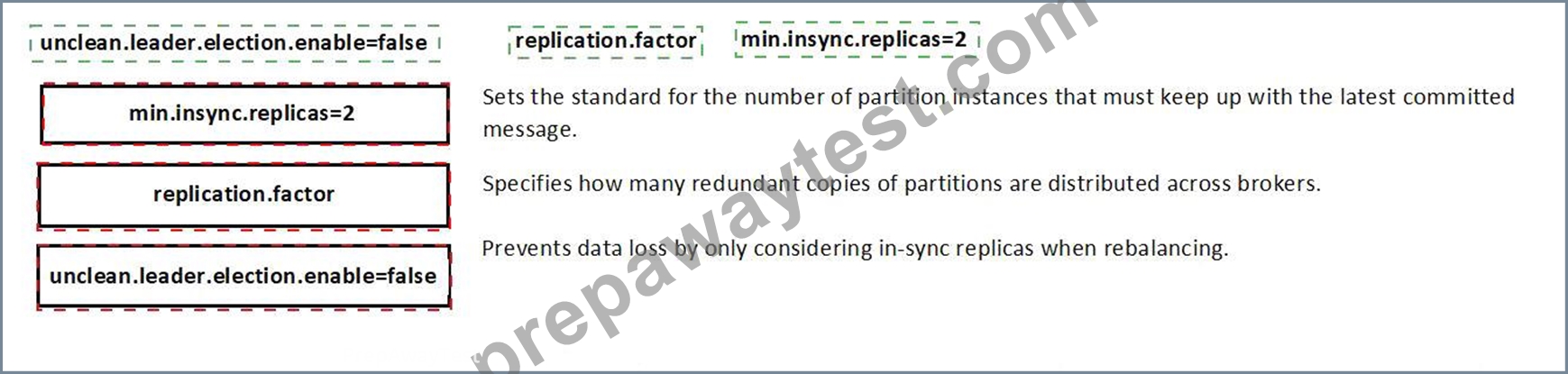
* unclean.leader.election.enable=false# Prevents data loss by only considering in-sync replicas when rebalancing.
* replication.factor# Specifies how many redundant copies of partitions are distributed across brokers.
* min.insync.replicas=2# Sets the standard for the number of partition instances that must keep up with the latest committed message.
* unclean.leader.election.enable=false ensures that onlyin-sync replicascan be elected as leaders. If disabled, an out-of-sync replica may become leader, potentially leading to data loss.
* replication.factor defineshow many brokerswill maintain copies of each partition, directly impacting durability and availability.
* min.insync.replicas determineshow many replicas must acknowledgea write when acks=all is used, enforcing write durability.
Reference:Apache Kafka Topic Configuration Documentation
NEW QUESTION # 114
In Avro, adding a field to a record without default is a __ schema evolution
- A. breaking
- B. full
- C. forward
- D. backward
Answer: C
Explanation:
Clients with old schema will be able to read records saved with new schema.
NEW QUESTION # 115
A kafka topic has a replication factor of 3 and min.insync.replicas setting of 2. How many brokers can go down before a producer with acks=all can't produce?
- A. 0
- B. 1
- C. 2
- D. 3
Answer: D
Explanation:
acks=all and min.insync.replicas=2 means we must have at least 2 brokers up for the partition to be available
NEW QUESTION # 116
Which partition assignment minimizes partition movements between two assignments?
- A. PartitionAssignor
- B. RangeAssignor
- C. StickyAssignor
- D. RoundRobinAssignor
Answer: C
Explanation:
TheStickyAssignortries to minimize partition movement bypreserving existing assignmentsas much as possible while still achieving a balanced assignment. This improvesconsumer stabilityand reduces rebalances.
From theKafka Consumer Assignor Documentation:
"The StickyAssignor attempts topreserve as many existing assignments as possible, which helps minimize partition movement between rebalances."
* RoundRobinAssignor focuses on even distribution, not stability.
* RangeAssignor groups partitions by topic and assigns them consecutively, but can lead to imbalances.
* PartitionAssignor is an abstract base class, not an assignor used directly.
Reference:Kafka Consumer Assignor Docs
NEW QUESTION # 117
Where are the dynamic configurations for a topic stored?
- A. On the Kafka broker file system
- B. In an internal Kafka topic __topic_configuratins
- C. In Zookeeper
- D. In server.properties
Answer: C
Explanation:
Dynamic topic configurations are maintained in Zookeeper.
NEW QUESTION # 118
A consumer wants to read messages from a specific partition of a topic. How can this be achieved?
- A. Call subscribe() passing TopicPartition as the argument
- B. Call subscribe(String topic, int partition) passing the topic and partition number as the arguments
- C. Call assign() passing a Collection of TopicPartitions as the argument
Answer: C
Explanation:
assign() can be used for manual assignment of a partition to a consumer, in which case subscribe() must not be used. Assign() takes a collection of TopicPartition object as an argument https://kafka.apache.org/23
/javadoc/org/apache/kafka/clients/consumer/KafkaConsumer.html#assign-java.util.Collection-
NEW QUESTION # 119
Match each configuration parameter with the correct deployment step in installing a Kafka connector.
Answer:
Explanation:
Explanation:
* 1st:Place the connector's JAR file in the directory specified by plugin.path
* 2nd:Restart the Kafka Connect cluster
* 3rd:Verify using REST API (/connector-plugins)
* 4th:Configure the connector
* 5th:(Repeat of 4th, duplicate step)
1st # Place the connector's JAR file in the directory specified by the plugin.path configuration.
2nd # Restart the Kafka Connect cluster.
3rd # Verify that the connector is installed by listing all available connectors using the Kafka Connect REST API (/connector-plugins).
4th # Configure the connector using a JSON or properties file with the necessary settings.
5th # Configure the connector using a JSON or properties file with the necessary settings.
Kafka Connect requires that custom connectors be placed in the directory defined by plugin.path. After restarting the cluster, you can use the REST API to confirm availability and then deploy the connector configuration.
FromKafka Connect Documentation:
"After placing the JAR in the plugin.path, you must restart the Connect cluster to pick it up. Use the
/connector-plugins REST endpoint to verify."
The duplication of configuration is an error in the question options and should occur only once.
Reference:Kafka Connect Plugin Installation Guide
NEW QUESTION # 120
What is the risk of increasing max.in.flight.requests.per.connection while also enabling retries in a producer?
- A. At least once delivery is not guaranteed
- B. Message order not preserved
- C. Reduce throughput
- D. Less resilient
Answer: B
Explanation:
Some messages may require multiple retries. If there are more than 1 requests in flight, it may result in messages received out of order. Note an exception to this rule is if you enable the producer settingenable.idempotence=true which takes care of the out of ordering case on its own. Seehttps://issues.apache.org/jira/browse/KAFKA-5494
NEW QUESTION # 121
Which message delivery semantic is guaranteed by Kafka Connect?
- A. Exactly once
- B. At most once
- C. At least once
Answer: C
NEW QUESTION # 122
A topic has three replicas and you set min.insync.replicas to 2. If two out of three replicas are not available, what happens when a consume request is sent to broker?
- A. An empty message will be returned
- B. A new leader for the partition will be elected
- C. NotEnoughReplicasException will be returned
- D. Data will be returned from the remaining in-sync replica
Answer: D
Explanation:
With this configuration, a single in-sync replica is still readable, but not writeable if the producer using acks=all
NEW QUESTION # 123
You have a topic with four partitions. The application reads from it using two consumers in a single consumer group.
Processing is CPU-bound, and lag is increasing.
What should you do?
- A. Add more consumers to increase the level of parallelism of the processing.
- B. Decrease the max.poll.records property of consumers.
- C. Add more partitions to the topic to increase the level of parallelism of the processing.
- D. Increase the max.poll.records property of consumers.
Answer: A
Explanation:
If the application isCPU-boundandlagging, addingmore consumersto the group will allow betterparallel processing, especially since the topic has4 partitions, allowing up to 4 active consumers.
FromKafka Consumer Group Docs:
"Kafka achieves parallelism by distributing partitions across consumers in a group. Adding consumers helps reduce lag if partitions are underutilized."
* B may help but requires repartitioning and coordination.
* C or D affects how much data is polled, not how fast it's processed.
Reference:Kafka Consumer Concepts > Parallelism and Scaling
NEW QUESTION # 124
Which is true about topic compaction?
- A. When a client produces a new event with an existing key, the old value is overwritten with the new value in the compacted log segment.
- B. Topic compaction does not remove old events; instead, when clients consume events from a compacted topic, they store events in a hashmap that maintains the latest value.
- C. Compaction will keep exactly one message per key after compaction of inactive log segments.
- D. When a client produces a new event with an existing key, the broker immediately deletes the offset of the existing event.
Answer: C
Explanation:
Log compactionensures that Kafka retains at least thelatest value per keyin a topic. Compaction happensin the backgroundand removes older records with the same keyin inactive log segments, not immediately.
From theKafka Documentation > Log Compaction:
"Kafka guarantees that thelast message for each keywill be retained in the log after compaction, even if earlier messages with the same key are deleted." So, D is correct. A is incorrect because compaction does not overwrite; it's a background process. B is incorrect-deletion is not immediate. C incorrectly suggests client-side hashmap behavior.
Reference:Apache Kafka Log Compaction Docs
NEW QUESTION # 125
Refer to the producer code below. It features a 'Callback' class with a method called 'onCompletion()'. When will the 'onCompletion()' method be Invoked?
producer.send(record, new MyCallback(record));
- A. When a consumer sends an acknowledgement to the producer
- B. When the producer batches the message
- C. When a broker sends an acknowledgement to the producer
- D. When the producer puts the message into its socket buffer
Answer: C
NEW QUESTION # 126
An ecommerce wesbite sells some custom made goods. What's the natural way of modeling this data in Kafka streams?
- A. Purchase as stream, Product as table, Customer as stream
- B. Purchase as stream, Product as stream, Customer as stream
- C. Purchase as stream, Product as table, Customer as table
- D. Purchase as table, Product as table, Customer as table
Answer: C
Explanation:
Mostly-static data is modeled as a table whereas business transactions should be modeled as a stream.
NEW QUESTION # 127
The producer code below features a Callback class with a method called onCompletion().
In the onCompletion() method, when the request is completed successfully, what does the value metadata.offset() represent?
- A. The sequential ID of the message committed into a partition
- B. The ID of the partition to which the message was committed
- C. The number of bytes that overflowed beyond a producer batch of messages
- D. Its position in the producer's batch of messages
Answer: A
Explanation:
The offset in the RecordMetadata object returned by the producerrepresents the position of the record in the partition- i.e., thesequential IDassigned by Kafka once the message is committed.
FromKafka Producer API Documentation:
"The offset is the position of the record in the partition. This is a unique, sequential number assigned by the broker."
* D refers to metadata.partition(), not offset().
* B and C are unrelated to how Kafka handles committed offsets.
Reference:Kafka Producer Java API > RecordMetadata
NEW QUESTION # 128
......
The CCDAK exam covers a wide range of topics, including Kafka architecture and components, data modeling and serialization, producer and consumer APIs, Kafka Connect, Kafka Streams, and security. CCDAK exam consists of 60 multiple-choice questions and must be completed within two hours. Candidates who pass the exam will receive a Confluent Certified Developer for Apache Kafka certificate, which is valid for two years. The CCDAK certification is a rigorous exam that requires a deep understanding of Kafka's architecture and APIs, and passing it is a significant achievement for any developer.
Revolutionary Guide To Exam Confluent Dumps: https://www.prepawaytest.com/Confluent/CCDAK-practice-exam-dumps.html
The CCDAK Exam Test For Brief Preparation: https://drive.google.com/open?id=1nL6aN8VBYI0S4hSjLpHQ4sQm2HSyiciL