

[2025] FCSS_ADA_AR-6.7 by FCSS in Security Operations Actual Free Exam Practice Test
Free FCSS in Security Operations FCSS_ADA_AR-6.7 Exam Question
Fortinet FCSS_ADA_AR-6.7 Exam Syllabus Topics:
| Topic | Details |
|---|---|
| Topic 1 |
|
| Topic 2 |
|
| Topic 3 |
|
| Topic 4 |
|
NEW QUESTION # 29
Which syntax will register a collector to the supervisor?
- A. phProvisionCollector -add <user><password><super ID><organization><collectorName>
- B. phProvisionCollector -add <user><password><collector IP><organization><superName>
- C. phProvisionCollector -add <user><password><super IP><organization><workerName>
- D. phProvisionCollector -add <user><password><collector IP><organizationid><collectorName>
Answer: C
Explanation:
The phProvisionCollector command is used to register a collector to the supervisor in FortiSIEM. The correct syntax requires:
*User → The admin username for authentication.
*Password → The password for authentication.
*Super IP → The IP address of the supervisor, which manages the collector.
*Organization → The organization to which the collector belongs.
*Worker Name → The name of the worker node responsible for handling events from this collector.
NEW QUESTION # 30
Why can collectorsnotbe defined before the worker upload address is set on the supervisor?
- A. Collectors receive the worker upload address during the registration process
- B. To ensure that the service provider has deployed at least one worker along with a supervisor
- C. Collectors can only upload data to a worker, and the supervisor is not a worker
- D. To ensure that the service provider has deployed a NFS server
Answer: A
Explanation:
In FortiSIEM, collectors must know where to upload event data. During registration, the supervisor provides the collector with the worker upload address.
The worker upload address tells the collector where to send logs after collection. If no worker upload address is set, the collector has no destination for its data, preventing proper registration.
NEW QUESTION # 31
When constructing FortiSIEM rules, it's important to:
- A. Prioritize rules based on the likelihood and impact of events?
- B. Make rules based on aesthetic preferences?
- C. Ensure rules are broad to cover all possible events?
- D. Frequently change rule conditions for variety?
Answer: A
NEW QUESTION # 32
Refer to the exhibit.
An administrator applies the rule exception shown in the exhibit.
How does this configuration impact the incident generation for that rule?
- A. Events will not be processed by the rule during the specified period.
- B. Incidents will not be generated during the specified period.
- C. Incidents will be generated without triggering an email alert during the specified period.
- D. Incidents will be generated only during the specified period.
Answer: B
Explanation:
From the exhibit, the rule exception is set for:
# Time Range: Starts at 00:00:00
# Duration: 2 days
# Recurrence Pattern: December 25th and December 26th
This means that during these two days (every year in December), the rule will not trigger incidents.
Rule exceptions temporarily suppress incident generation during the specified period.
Events are still processed, but no incidents are generated.
NEW QUESTION # 33
Refer to the exhibit.
The rule evaluates multiple VPN logon failures within a ten-minute window. Consider the following VPN failure events received within a ten-minute window:
How many incidents are generated?
- A. 0
- B. 1
- C. 2
- D. 3
Answer: D
Explanation:
The rule triggers an incident when there are two or more VPN logon failures within a 10-minute window, grouped by Source IP, Reporting Device, Reporting IP, and User. Let's analyze the events:
Breakdown of Events:
1. Reporting IP: 1.1.1.1, Source IP: 2.2.2.2, Device: FortiGate, User: Sarah
2. Reporting IP: 1.1.1.1, Source IP: 2.2.2.2, Device: FortiGate, User: John
3. Reporting IP: 1.1.1.3, Source IP: 2.2.2.2, Device: FortiGate2, User: Tom
4. Reporting IP: 1.1.1.3, Source IP: 2.2.2.2, Device: FortiGate2, User: John
5. Reporting IP: 1.1.1.3, Source IP: 2.2.2.2, Device: FortiGate2, User: Sarah
6. Reporting IP: 1.1.1.1, Source IP: 2.2.2.2, Device: FortiGate, User: Tom Now, applying the grouping criteria (Source IP, Reporting Device, Reporting IP, and User):
# Group 1: (1.1.1.1, 2.2.2.2, FortiGate, John) # 1 occurrence (not enough)
# Group 2: (1.1.1.1, 2.2.2.2, FortiGate, Sarah) # 1 occurrence (not enough)
# Group 3: (1.1.1.1, 2.2.2.2, FortiGate, Tom) # 2 occurrences (incident triggered)
# Group 4: (1.1.1.3, 2.2.2.2, FortiGate2, John) # 2 occurrences (incident triggered)
# Group 5: (1.1.1.3, 2.2.2.2, FortiGate2, Sarah) # 1 occurrence (not enough)
# Group 6: (1.1.1.3, 2.2.2.2, FortiGate2, Tom) # 1 occurrence (not enough) Final Incident Count:
# One incident for Group 3 (Tom on FortiGate)
# One incident for Group 4 (John on FortiGate2)
NEW QUESTION # 34
Refer to the exhibit.
Why is the windows device still in the CMDB, even though the administrator uninstalled the windows agent?
- A. The device was not installed properly
- B. The device has performance jobs assigned
- C. The device must be deleted manually from the CMDB
- D. The device mustbe deleted from backend of FortiSIEM
Answer: C
Explanation:
InFortiSIEM, when an agent isuninstalled from a Windows device, the deviceremains in the CMDB (Configuration Management Database)until it ismanually removed.
#Uninstalling the agent does not automatically remove the device from the CMDB.
# CMDB maintains discovered deviceseven if they no longer report logs, ensuring historical tracking.
# Administrators mustmanually deletethe device from theCMDB > Devicessection.
NEW QUESTION # 35
Where are the SQLite databases that are used for the baselining, stored?
- A. /opt/phoenix/bin
- B. /opt/phoenix/cache
- C. /opt/phoenix/config
- D. /opt/phoenix/delta
Answer: A
NEW QUESTION # 36
Which three processes are collector processes? (Choose three.)
- A. phRuleMaster
- B. phAgentManager
- C. phReportMaster
- D. phParser
- E. phMonitorAgent
Answer: B,D,E
Explanation:
These three processes are essential for aFortiSIEM collector, as they handle event parsing, agent communication, and system monitoring.
#phParseris responsible forparsing and processing collected logsbefore forwarding them.
#phAgentManagermanages agent communication, ensuring logs are received and forwarded correctly.
#phMonitorAgentmonitors the health of the collector itself, reporting system status to the FortiSIEM supervisor.
phReportMasterandphRuleMasterdo not run on collectors. They are supervisor/worker processes handling reporting and rule evaluation, respectively.
NEW QUESTION # 37
How can you invoke an integration policy on FortiSIEM rules?
- A. Through remediation scripts
- B. Through External Authentication settings
- C. Through Notification Policy settings
- D. Through Incident Notification settings
Answer: C
NEW QUESTION # 38
Refer to the exhibit.
Which device would run the processes shown in the exhibit?
- A. Worker
- B. Collector
- C. Linux Agent
- D. Supervisor
Answer: A
NEW QUESTION # 39
When explaining FortiSIEM rule processing, which of the following elements is crucial?
- A. The color-coding of FortiSIEM logs?
- B. The brand of servers on which FortiSIEM is installed?
- C. The visual design of the FortiSIEM interface?
- D. The sequence in which rules are processed?
Answer: D
NEW QUESTION # 40
Refer to the exhibit.
The exhibit shows the output of an SQL command that an administrator ran to view the natural_id value, after logging into the Postgres database.
What does the natural_id value identify?
- A. An agent
- B. The collector
- C. The worker
- D. The supervisor
Answer: B
NEW QUESTION # 41
How can you empower SOC by deploying FortiSOAR? (Choose three.)
- A. Baseline user and traffic behavior
- B. Reduce human error
- C. Aggregate logs from distributed systems
- D. Collaborative knowledge sharing
- E. Address analyst skills gap
Answer: B,D,E
Explanation:
Collaborative knowledge sharing: FortiSOAR enables security teams to share knowledge, automate workflows, and improve incident response efficiency by centralizing intelligence and standardizing processes.
Addressing analyst skills gap: By automating repetitive tasks and providing guided response playbooks, FortiSOAR helps SOC teams compensate for skill shortages and improve operational effectiveness.
Reducing human error: Automation and predefined workflows minimize manual interventions, reducing the likelihood of errors in incident detection, response, and remediation.
NEW QUESTION # 42
Refer to the exhibit.
The profile database contains CPU utilization values from day one. At midnight on the second day, the CPU utilization values from the daily database will be merged with the profile database.
In the profile database, in the Hour of Day column where 9 is the value, what will be the updated minimum, maximum, and average CPU utilization values?
- A. Min CPU Util=32.31, Max CPU
Util=33.50 and AVG CPU
Util 33.50 - B. Min CPU Util=32.31, Max CPU
Util=33.50 and AVG CPU
Util=32.67 - C. Min CPU Util=32.31, Max CPU
Util=32.31 and AVG CPU
Util=32.31 - D. Min CPU Util=33.50, Max CPU
Util=33.50 and AVG CPU
Util=33.50
Answer: B
Explanation:
At midnight, the daily database values merge into the profile database. The new values for Hour 9 are calculated as follows:
*Minimum CPU Utilization: The new minimum is the lower of the existing (32.31) and new (33.50) values → 32.31
*Maximum CPU Utilization: The new maximum is the higher of the existing (32.31) and new (33.50) values → 33.50
*Average CPU Utilization:
*The previous average was 32.31 (from one point).
*The new value from the daily database is 33.50 (one additional point).
*The new average is calculated as:
Thus, after merging, the updated profile database values for Hour 9 are:
*Min CPU Util = 32.31
*Max CPU Util = 33.50
*Avg CPU Util = 32.67
NEW QUESTION # 43
Which of the following is a primary reason to deploy FortiSIEM agents on both Windows and Linux platforms?
- A. To increase the speed of the SOC server.
- B. To provide redundancy in case one platform fails.
- C. To cover a diverse range of operating systems in an environment.
- D. To prevent users from installing unauthorized software.
Answer: C
NEW QUESTION # 44
What is the hourly bucket used in baselining?
- A. To store data for specific baselines for every hour of the day during weekdays and weekends
- B. To store data for specific baselines during peak business hours of weekdays
- C. To store hourly baselines reports for every hour of the day during weekdays and weekends
- D. To store data for specific baselines during the weekend, if there is a spike in network activity
Answer: A
Explanation:
InFortiSIEM baselining, anhourly bucketis used to maintainhourly-specific statistical baselines. This helps detect anomalies by comparing current activity against historical norms foreach hour of the day, separately forweekdays and weekends.
The system maintainshourly profiles, ensuring that anomalies are detected based on similar timeframes. This approach prevents false positives due to natural variations in network activity across different times of the day and different days of the week.
NEW QUESTION # 45
Which of the following can be an outcome if a FortiSIEM rule detects a suspicious login attempt?
- A. Instantly upgrading the FortiSIEM version?
- B. Automatically opening a support ticket with Fortinet?
- C. Changing the passwords of all users in the system?
- D. Sending an alert to a predefined email address?
Answer: D
NEW QUESTION # 46
Refer to the exhibit.
The rule evaluates multiple VPN logon failures within a ten-minute window.
Consider the following VPN failure events received within a ten-minute window:
How many incidents are generated?
- A. 0
- B. 1
- C. 2
- D. 3
Answer: B
NEW QUESTION # 47
Refer to the exhibit.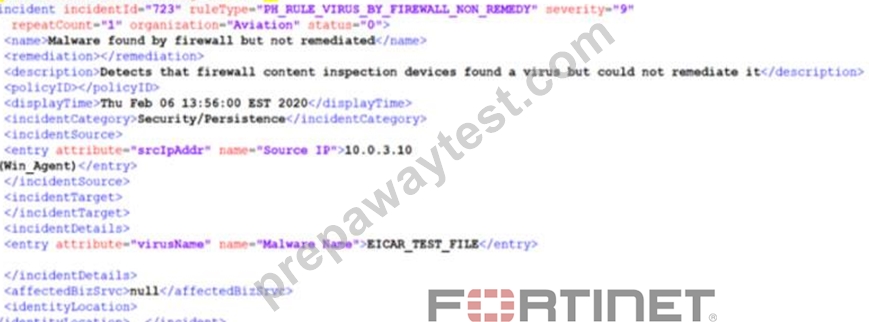
An administrator wants to remediate the incident from FortiSIEM shown in the exhibit.
What option is available to the administrator?
- A. Run the block MAC FortiOS.
- B. Quarantine IP FortiClient
- C. Run the block IP FortiOS 5.4
- D. Run the block domain Windows DNS
Answer: C
NEW QUESTION # 48
Refer to the exhibit.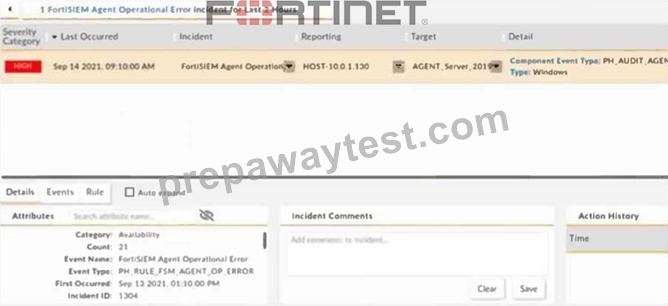
How long has the UEBA agent been operationally down?
- A. 21 Hours
- B. 2 Hours
- C. 9 Hours
- D. 20 Hours
Answer: D
Explanation:
Based on the provided exhibit, we can determine how long the UEBA agent has been operationally down by looking at the "First Occurred" and "Last Occurred" timestamps.
*First Occurred: Sep 13, 2021, at 01:10 PM
*Last Occurred: Sep 14, 2021, at 09:10 AM
From Sep 13, 01:10 PM to Sep 14, 01:10 AM → 12 hours
From Sep 14, 01:10 AM to Sep 14, 09:10 AM → 8 hours
Total downtime = 12 + 8 = 20 hours
NEW QUESTION # 49
What are the two SQLite databases that are used for baseline data? (Choose two.)
- A. Daily database
- B. Weekly database
- C. Profile database
- D. Event database
Answer: A,C
NEW QUESTION # 50
FortiSIEM's UEBA capabilities primarily focus on:
- A. Monitoring and analyzing behavior patterns to identify potential risks?
- B. Streamlining the software update process?
- C. Ensuring all users have similar access privileges?
- D. Providing encryption algorithms for data transfers?
Answer: A
NEW QUESTION # 51
FortiSOAR is primarily used for:
- A. Storing large amounts of data?
- B. Automating response actions to security incidents?
- C. Designing network topologies?
- D. Streamlining administrative tasks like adding new users?
Answer: B
NEW QUESTION # 52
The MITRE ATT&CK® framework is primarily designed to:
- A. Provide a guide for hardware installations?
- B. Boost the performance of security tools?
- C. Recommend cybersecurity training programs?
- D. Offer a detailed map of adversary tactics and techniques?
Answer: D
NEW QUESTION # 53
......
Fortinet FCSS_ADA_AR-6.7 Actual Questions and Braindumps: https://www.prepawaytest.com/Fortinet/FCSS_ADA_AR-6.7-practice-exam-dumps.html
FCSS_ADA_AR-6.7 dumps & FCSS in Security Operations sure practice dumps: https://drive.google.com/open?id=1WbG3eCyggvGN584W9VH910rOt7Y3OKY5