

[2022] New DP-300 exam Free Sample Questions to Practice
Cover Real DP-300 Exam Questions Make Sure You 100% Pass
Query Performance Optimization
- Evaluation of Performance improvements
- Determining the ideal Dynamic Management Views (DMVs) to collect information relating query performance
- Using DMVs to identify performance issues
- Implementation and identification of index changes for queries
- Assessing the importance of hints in query performance
- Defining query construct modifications
- Reviewing query plans
- Determining the ideal execution plan
- Identification of problem sections in execution plans
- Extraction of query plans from the Query Store
- Reviewing index design and database table
- Identifying issues on data quality and data duplication
- Database tables
- Assessing index design
- Validating data types
- Recommending table and index storage including file groups
- Evaluation of table partitioning strategy
- Compression for indexes and tables
Get information about the Solution for Microsoft DP-300 Exam
PrepAwayTest offer you authentic Microsoft DP-300 questions. Apart from this we also provide the Microsoft DP-300 practice test which includes all the practice questions for the Microsoft DP-300, Microsoft DP-300 exam dumps that will ensure 100% passing surety and the simple user interface of Microsoft DP-300 practice test. Our hired professionals who passed their Microsoft DP-300 well contribute to making Microsoft DP-300 exam dumps updated with Microsoft DP-300 new questions to ensure candidates to clear their Microsoft DP-300 certification exam at the first attempt.
When you start preparing for the certification exam, there are some basic but powerful methods that allow you to identify everything in your preparation. Many experts prepare the certification from books, so they are dissatisfied if unfortunately, they fail in the exam. The fact is that understanding the root of the information is only a tiny part of the preparation that most individuals have to pass the certification exams. PrepAwayTest provides you Exam Simulator software to practice the exam with real-time experience. Ask the actual exam questions and check your progress. You can take the test as many times as you like. There are no limits, this will make exam preparation very fast and efficient. When you start earning 100% points with a full set of questions, you're ready to take the actual exam. Sign up to try the Test Center and enjoy its success.
We know that many students are now certified, but not everyone is skilled. That is why we hire highly skilled and qualified specialists in the sector. Certified professionals not only help us to create guides or preparations but also guide our crew for later products. If you are looking at our expertise, thousands of clients trust us and purchase our products.
After taking and understanding our modules, you will pass the exam. But it doesn't stop there; you will always be successful in your profession thanks to our extensive guides. In the future, you will be capable to make your products.
The candidate will not have to take the Microsoft DP-300 twice because with the help of the Microsoft DP-300 exam dumps the Candidate will have every valuable material required to pass the Microsoft DP-300 Exam. We are providing the latest and actual questions and that is the reason why this is the one that he needs to use and there are no chances to fail when a candidate will have valid Microsoft DP-300 exam dumps from PrepAwayTest. We have the guarantee that the questions that we have will be the ones that will pass the candidate in the Microsoft DP-300 Exam in the very first attempt.
NEW QUESTION 14
You have an Azure SQL database named DB1. You run a query while connected to DB1.
You review the actual execution plan for the query, and you add an index to a table referenced by the query.
You need to compare the previous actual execution plan for the query to the Live Query Statistics.
What should you do first in Microsoft SQL Server Management Studio (SSMS)?
- A. Save the actual execution plan.
- B. Run the SET SHOWPLAN_ALLTransact-SQL statement.
- C. Enable Query Store for DB1.
- D. For DB1, set QUERY_CAPTURE_MODE of Query Store to All.
Answer: A
Explanation:
The Plan Comparison menu option allows side-by-side comparison of two different execution plans, for easier identification of similarities and changes that explain the different behaviors for all the reasons stated above.
This option can compare between:
Two previously saved execution plan files (.sqlplan extension).
One active execution plan and one previously saved query execution plan.
Two selected query plans in Query Store.
NEW QUESTION 15
You have an Azure SQL database.
You discover that the plan cache is full of compiled plans that were used only once.
You run the select * from sys.database_scoped_configurations Transact-SQL command and receive the results shown in the following table.
You need relieve the memory pressure.
What should you configure?
- A. ACCELERATED_PLAN_FORCING
- B. QUERY_OPTIMIZER_HOTFIXES
- C. OPTIMIZE_FOR_AD_HOC_WORKLOADS
- D. LEGACY_CARDINALITY_ESTIMATION
Answer: C
Explanation:
OPTIMIZE_FOR_AD_HOC_WORKLOADS = { ON | OFF }
Enables or disables a compiled plan stub to be stored in cache when a batch is compiled for the first time. The default is OFF. Once the database scoped configuration OPTIMIZE_FOR_AD_HOC_WORKLOADS is enabled for a database, a compiled plan stub will be stored in cache when a batch is compiled for the first time. Plan stubs have a smaller memory footprint compared to the size of the full compiled plan.
Incorrect Answers:
A: LEGACY_CARDINALITY_ESTIMATION = { ON | OFF | PRIMARY }
Enables you to set the query optimizer cardinality estimation model to the SQL Server 2012 and earlier version independent of the compatibility level of the database. The default is OFF, which sets the query optimizer cardinality estimation model based on the compatibility level of the database.
B: QUERY_OPTIMIZER_HOTFIXES = { ON | OFF | PRIMARY }
Enables or disables query optimization hotfixes regardless of the compatibility level of the database. The default is OFF, which disables query optimization hotfixes that were released after the highest available compatibility level was introduced for a specific version (post-RTM).
Reference:
https://docs.microsoft.com/en-us/sql/t-sql/statements/alter-database-scoped-configuration-transact-sql
NEW QUESTION 16
You need to recommend an availability strategy for an Azure SQL database. The strategy must meet the
following requirements:
* Support failovers that do not require client applications to change their connection strings.
* Replicate the database to a secondary Azure region.
* Support failover to the secondary region.
What should you include in the recommendation?
- A. failover groups
- B. geo-replication
- C. Availability Zones
- D. transactional replication
Answer: B
Explanation:
Section: [none]
Explanation:
Active geo-replication is an Azure SQL Database feature that allows you to create readable secondary
databases of individual databases on a server in the same or different data center (region).
Incorrect Answers:
C: Availability Zones are unique physical locations within a region. Each zone is made up of one or more
datacenters equipped with independent power, cooling, and networking.
Reference:
https://docs.microsoft.com/en-us/azure/azure-sql/database/active-geo-replication-overview
NEW QUESTION 17
You have the following Transact-SQL query.
Which column returned by the query represents the free space in each file?
- A. ColumnD
- B. ColumnA
- C. ColumnC
- D. ColumnB
Answer: C
Explanation:
Section: [none]
Explanation:
Example:
Free space for the file in the below query result set will be returned by the FreeSpaceMB column.
SELECT DB_NAME() AS DbName,
name AS FileName,
type_desc,
size/128.0 AS CurrentSizeMB,
size/128.0 - CAST(FILEPROPERTY(name, 'SpaceUsed') AS INT)/128.0 AS FreeSpaceMB
FROM sys.database_files
WHERE type IN (0,1);
Reference:
https://www.sqlshack.com/how-to-determine-free-space-and-file-size-for-sql-server-databases/
NEW QUESTION 18
You have two Azure virtual machines named VM1 and VM2 that run Windows Server 2019. VM1 and VM2 each host a default Microsoft SQL Server 2019 instance. VM1 contains a database named DB1 that is backed up to a file named D:\DB1.bak.
You plan to deploy an Always On availability group that will have the following configurations:
VM1 will host the primary replica of DB1.
VM2 will host a secondary replica of DB1.
You need to prepare the secondary database on VM2 for the availability group.
How should you complete the Transact-SQL statement? To answer, select the appropriate options in the answer area.
Answer:
Explanation: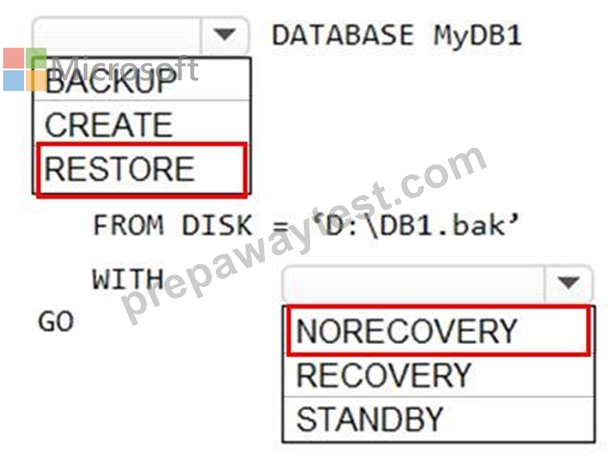
Reference:
https://docs.microsoft.com/en-us/sql/database-engine/availability-groups/windows/manually-prepare-a-secondary-database-for-an-availability-group-sql-server?view=sql-server-ver15
NEW QUESTION 19
You have an Azure Databricks resource.
You need to log actions that relate to changes in compute for the Databricks resource.
Which Databricks services should you log?
- A. SSH
- B. DBFS
- C. jobs
- D. workspace
- E. clusters
Answer: D
Explanation:
Cloud Provider Infrastructure Logs.
Databricks logging allows security and admin teams to demonstrate conformance to data governance standards within or from a Databricks workspace. Customers, especially in the regulated industries, also need records on activities like:
User access control to cloud data storage
Cloud Identity and Access Management roles
User access to cloud network and compute
Azure Databricks offers three distinct workloads on several VM Instances tailored for your data analytics workflow-the Jobs Compute and Jobs Light Compute workloads make it easy for data engineers to build and execute jobs, and the All-Purpose Compute workload makes it easy for data scientists to explore, visualize, manipulate, and share data and insights interactively.
Reference:
https://databricks.com/blog/2020/03/25/trust-but-verify-with-databricks.html
NEW QUESTION 20
You have a resource group named App1Dev that contains an Azure SQL Database server named DevServer1. DevServer1 contains an Azure SQL database named DB1. The schema and permissions for DB1 are saved in a Microsoft SQL Server Data Tools (SSDT) database project.
You need to populate a new resource group named App1Test with the DB1 database and an Azure SQL Server named TestServer1. The resources in App1Test must have the same configurations as the resources in App1Dev.
Which four actions should you perform in sequence? To answer, move the appropriate actions from the list of actions to the answer area and arrange them in the correct order.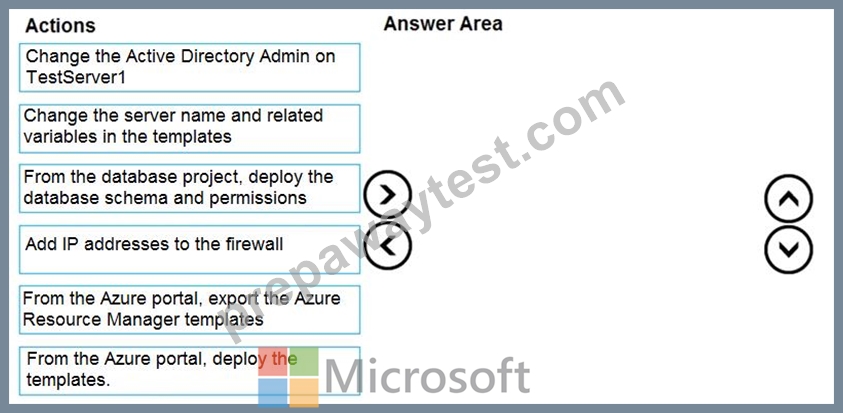
Answer:
Explanation:
1 - From the Azure portal, export the Azure Resource Manager tamplates
2 - Change the server name and related variables in the tamplates
3 - From the Azure portal, deploy the templates.
4 - From the database schema and permissions
NEW QUESTION 21
You have an Azure SQL database named DB3.
You need to provide a user named DevUser with the ability to view the properties of DB3 from Microsoft SQL
Server Management Studio (SSMS) as shown in the exhibit. (Click the Exhibit tab.)
Which Transact-SQL command should you run?
- A. GRANT SELECT TO DevUser
- B. GRANT VIEW DEFINITION TO DevUser
- C. GRANT SHOWPLAN TO DevUser
- D. GRANT VIEW DATABASE STATE TO DevUser
Answer: D
Explanation:
Section: [none]
Explanation:
The exhibits displays Database [State] properties.
To query a dynamic management view or function requires SELECT permission on object and VIEW SERVER
STATE or VIEW DATABASE STATE permission.
Reference:
https://docs.microsoft.com/en-us/sql/relational-databases/databases/database-properties-options-page
NEW QUESTION 22
You have a Microsoft SQL Server 2019 instance in an on-premises datacenter. The instance contains a 4-TB database named DB1.
You plan to migrate DB1 to an Azure SQL Database managed instance.
What should you use to minimize downtime and data loss during the migration?
- A. log shipping
- B. distributed availability groups
- C. database mirroring
- D. Database Migration Assistant
Answer: D
Explanation:
Ref: https://docs.microsoft.com/en-us/azure/dms/tutorial-sql-server-to-azure-sql
NEW QUESTION 23
DRAG DROP
You have SQL Server 2019 on an Azure virtual machine that contains an SSISDB database.
A recent failure causes the master database to be lost.
You discover that all Microsoft SQL Server integration Services (SSIS) packages fail to run on the virtual
machine.
Which four actions should you perform in sequence to resolve the issue? To answer, move the appropriate
actions from the list of actions to the answer area and arrange them in the correct.
Select and Place:
Answer:
Explanation:
Section: [none]
Explanation:
Step 1: Attach the SSISDB database
Step 2: Turn on the TRUSTWORTHY property and the CLR property
If you are restoring the SSISDB database to an SQL Server instance where the SSISDB catalog was never
created, enable common language runtime (clr)
Step 3: Open the master key for the SSISDB database
Restore the master key by this method if you have the original password that was used to create SSISDB.
open master key decryption by password = 'LS1Setup!' --'Password used when creating SSISDB'
Alter Master Key Add encryption by Service Master Key
Step 4: Encrypt a copy of the mater key by using the service master key
Reference:
https://docs.microsoft.com/en-us/sql/integration-services/backup-restore-and-move-the-ssis-catalog
NEW QUESTION 24
You need to recommend a configuration for ManufacturingSQLDb1 after the migration to Azure. The solution must meet the business requirements.
What should you include in the recommendation? To answer, select the appropriate options in the answer area.
NOTE: Each correct selection is worth one point.
Answer:
Explanation:
Reference:
https://technet.microsoft.com/windows-server-docs/failover-clustering/deploy-cloud-witness
https://azure.microsoft.com/en-us/support/legal/sla/load-balancer/v1_0/
NEW QUESTION 25
You create five Azure SQL Database instances on the same logical server.
In each database, you create a user for an Azure Active Directory (Azure AD) user named User1.
User1 attempts to connect to the logical server by using Azure Data Studio and receives a login error.
You need to ensure that when User1 connects to the logical server by using Azure Data Studio, User1 can see all the databases.
What should you do?
- A. Create User1 in the master database.
- B. Assign User1 the db_datareader role for the databases that Userl creates.
- C. Grant select on sys.databases to public in the master database.
- D. Assign User1 the db_datareader role for the master database.
Answer: A
Explanation:
Reference:
https://docs.microsoft.com/en-us/azure/azure-sql/database/logins-create-manage
NEW QUESTION 26
You have an Azure SQL database named DB1. The automatic tuning options for DB1 are configured as shown in the following exhibit.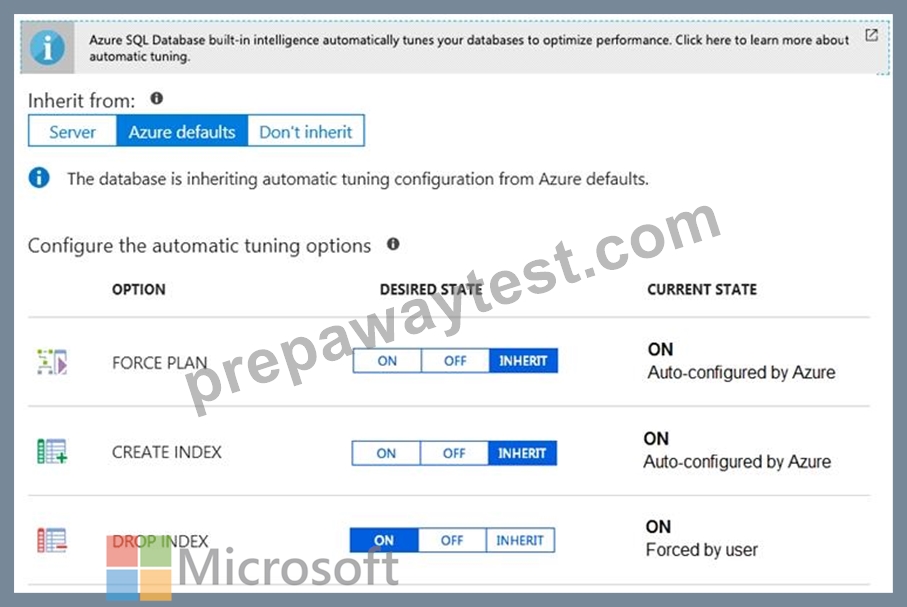
For each of the following statements, select Yes if the statement is true. Otherwise, select No.
NOTE: Each correct selection is worth one point.
Answer:
Explanation:
NEW QUESTION 27
HOTSPOT
From a website analytics system, you receive data extracts about user interactions such as downloads, link clicks, form submissions, and video plays.
The data contains the following columns:
You need to design a star schema to support analytical queries of the data. The star schema will contain four tables including a date dimension.
To which table should you add each column? To answer, select the appropriate options in the answer area.
NOTE: Each correct selection is worth one point.
Hot Area:
Answer:
Explanation:
Section: [none]
Explanation:
Box 1: FactEvents
Fact tables store observations or events, and can be sales orders, stock balances, exchange rates, temperatures, etc.
Box 2: DimChannel
Dimension tables describe business entities - the things you model. Entities can include products, people, places, and concepts including time itself. The most consistent table you'll find in a star schema is a date dimension table. A dimension table contains a key column (or columns) that acts as a unique identifier, and descriptive columns.
Box 3: DimEvent
Reference:
https://docs.microsoft.com/en-us/power-bi/guidance/star-schema
NEW QUESTION 28
You have an Azure SQL database named DB1.
You need to ensure that DB1 will support automatic failover without data loss if a datacenter fails. The solution must minimize costs.
Which deployment option and pricing tier should you configure?
- A. Azure SQL Database serverless
- B. Azure SQL Database Premium
- C. Azure SQL Database managed instance Business Critical
- D. Azure SQL Database Standard
Answer: B
Explanation:
By default, the cluster of nodes for the premium availability model is created in the same datacenter. With the introduction of Azure Availability Zones, SQL Database can place different replicas of the Business Critical database to different availability zones in the same region. To eliminate a single point of failure, the control ring is also duplicated across multiple zones as three gateway rings (GW). The routing to a specific gateway ring is controlled by Azure Traffic Manager (ATM). Because the zone redundant configuration in the Premium or Business Critical service tiers does not create additional database redundancy, you can enable it at no extra cost. By selecting a zone redundant configuration, you can make your Premium or Business Critical databases resilient to a much larger set of failures, including catastrophic datacenter outages, without any changes to the application logic. You can also convert any existing Premium or Business Critical databases or pools to the zone redundant configuration.
Incorrect Answers:
C. This feature is not available in SQL Managed Instance.
Reference:
https://docs.microsoft.com/en-us/azure/azure-sql/database/high-availability-sla
NEW QUESTION 29
You are building an Azure virtual machine.
You allocate two 1-TiB, P30 premium storage disks to the virtual machine. Each disk provides 5,000 IOPS.
You plan to migrate an on-premises instance of Microsoft SQL Server to the virtual machine. The instance has a database that contains a 1.2-TiB data file. The database requires 10,000 IOPS.
You need to configure storage for the virtual machine to support the database.
Which three objects should you create in sequence? To answer, move the appropriate objects from the list of objects to the answer area and arrange them in the correct order.
Answer:
Explanation:
1 - a storage pool
2 - a virtual disk that uses stripe layout
3 - a volume
Reference:
https://hanu.com/hanu-how-to-striping-of-disks-for-azure-sql-server/
NEW QUESTION 30
You have a Microsoft SQL Server database named DB1 that contains a table named Table1.
The database role membership for a user named User1 is shown in the following exhibit.
Use the drop-down menus to select the answer choice that completes each statement based on the information presented in the graphic.
NOTE: Each correct selection is worth one point.
Answer:
Explanation:
Explanation:
Box 1: delete a row from Table1
Members of the db_datawriter fixed database role can add, delete, or change data in all user tables.
Box 2: db_datareader
Members of the db_datareader fixed database role can read all data from all user tables.
Reference:
https://docs.microsoft.com/en-us/sql/relational-databases/security/authentication-access/database-level-roles
NEW QUESTION 31
You have 40 Azure SQL databases, each for a different customer. All the databases reside on the same Azure SQL Database server.
You need to ensure that each customer can only connect to and access their respective database.
Which two actions should you perform? Each correct answer presents part of the solution.
NOTE: Each correct selection is worth one point.
- A. Implement Always Encrypted.
- B. Create users in each database.
- C. Implement row-level security (RLS).
- D. Configure the database firewall.
- E. Create logins in the master database.
- F. Configure the server firewall.
Answer: B,D
Explanation:
Manage database access by adding users to the database, or allowing user access with secure connection strings.
Database-level firewall rules only apply to individual databases.
Reference:
https://docs.microsoft.com/en-us/azure/azure-sql/database/secure-database-tutorial
NEW QUESTION 32
You have an Azure SQL database named DB1 that contains a private certificate named Sales. The private key for Sales is encrypted with a password. You need to change the password for the private key. Which Transact-SQL statement should you run?
A)
B)
C)
D)
- A. Option C
- B. Option D
- C. Option B
- D. Option A
Answer: A
NEW QUESTION 33
Note: This question is part of a series of questions that present the same scenario. Each question in the series contains a unique solution that might meet the stated goals. Some question sets might have more than one correct solution, while others might not have a correct solution.
After you answer a question in this section, you will NOT be able to return to it. As a result, these questions will not appear in the review screen.
You have two Azure SQL Database servers named Server1 and Server2. Each server contains an Azure SQL database named Database1.
You need to restore Database1 from Server1 to Server2. The solution must replace the existing Database1 on Server2.
Solution: From Microsoft SQL Server Management Studio (SSMS), you rename Database1 on Server2 as Database2. From the Azure portal, you create a new database on Server2 by restoring the backup of Database1 from Server1, and then you delete Database2.
Does this meet the goal?
- A. Yes
- B. No
Answer: B
Explanation:
Section: [none]
Explanation:
Instead restore Database1 from Server1 to the Server2 by using the RESTORE Transact-SQL command and the REPLACE option.
Note: REPLACE should be used rarely and only after careful consideration. Restore normally prevents accidentally overwriting a database with a different database. If the database specified in a RESTORE statement already exists on the current server and the specified database family GUID differs from the database family GUID recorded in the backup set, the database is not restored. This is an important safeguard.
Reference:
https://docs.microsoft.com/en-us/sql/t-sql/statements/restore-statements-transact-sql Testlet 1 This is a case study. Case studies are not timed separately. You can use as much exam time as you would like to complete each case. However, there may be additional case studies and sections on this exam.
You must manage your time to ensure that you are able to complete all questions included on this exam in the time provided.
To answer the questions included in a case study, you will need to reference information that is provided in the case study. Case studies might contain exhibits and other resources that provide more information about the scenario that is described in the case study. Each question is independent of the other questions in this case study.
At the end of this case study, a review screen will appear. This screen allows you to review your answers and to make changes before you move to the next section of the exam. After you begin a new section, you cannot return to this section.
To start the case study
To display the first question in this case study, click the Next button. Use the buttons in the left pane to explore the content of the case study before you answer the questions. Clicking these buttons displays information such as business requirements, existing environment, and problem statements. If the case study has an All Information tab, note that the information displayed is identical to the information displayed on the subsequent tabs. When you are ready to answer a question, click the Question button to return to the question.
Overview
Litware, Inc. is a renewable energy company that has a main office in Boston. The main office hosts a sales department and the primary datacenter for the company.
Physical Locations
Litware has a manufacturing office and a research office is separate locations near Boston. Each office has its own datacenter and internet connection.
Existing Environment
Network Environment
The manufacturing and research datacenters connect to the primary datacenter by using a VPN.
The primary datacenter has an ExpressRoute connection that uses both Microsoft peering and private peering.
The private peering connects to an Azure virtual network named HubVNet.
Identity Environment
Litware has a hybrid Azure Active Directory (Azure AD) deployment that uses a domain named litwareinc.com.
All Azure subscriptions are associated to the litwareinc.com Azure AD tenant.
Database Environment
The sales department has the following database workload:
* An on-premises named SERVER1 hosts an instance of Microsoft SQL Server 2012 and two 1-TB databases.
* A logical server named SalesSrv01A contains a geo-replicated Azure SQL database named SalesSQLDb1.
SalesSQLDb1 is in an elastic pool named SalesSQLDb1Pool. SalesSQLDb1 uses database firewall rules and contained database users.
* An application named SalesSQLDb1App1 uses SalesSQLDb1.
The manufacturing office contains two on-premises SQL Server 2016 servers named SERVER2 and SERVER3. The servers are nodes in the same Always On availability group. The availability group contains a database named ManufacturingSQLDb1 Database administrators have two Azure virtual machines in HubVnet named VM1 and VM2 that run Windows Server 2019 and are used to manage all the Azure databases.
Licensing Agreement
Litware is a Microsoft Volume Licensing customer that has License Mobility through Software Assurance.
Current Problems
SalesSQLDb1 experiences performance issues that are likely due to out-of-date statistics and frequent blocking queries.
Requirements
Planned Changes
Litware plans to implement the following changes:
* Implement 30 new databases in Azure, which will be used by time-sensitive manufacturing apps that have varying usage patterns. Each database will be approximately 20 GB.
* Create a new Azure SQL database named ResearchDB1 on a logical server named ResearchSrv01.
ResearchDB1 will contain Personally Identifiable Information (PII) data.
* Develop an app named ResearchApp1 that will be used by the research department to populate and access ResearchDB1.
* Migrate ManufacturingSQLDb1 to the Azure virtual machine platform.
* Migrate the SERVER1 databases to the Azure SQL Database platform.
Technical Requirements
Litware identifies the following technical requirements:
* Maintenance tasks must be automated.
* The 30 new databases must scale automatically.
* The use of an on-premises infrastructure must be minimized.
* Azure Hybrid Use Benefits must be leveraged for Azure SQL Database deployments.
* All SQL Server and Azure SQL Database metrics related to CPU and storage usage and limits must be analyzed by using Azure built-in functionality.
Security and Compliance Requirements
Litware identifies the following security and compliance requirements:
* Store encryption keys in Azure Key Vault.
* Retain backups of the PII data for two months.
* Encrypt the PII data at rest, in transit, and in use.
* Use the principle of least privilege whenever possible.
* Authenticate database users by using Active Directory credentials.
* Protect Azure SQL Database instances by using database-level firewall rules.
* Ensure that all databases hosted in Azure are accessible from VM1 and VM2 without relying on public endpoints.
Business Requirements
Litware identifies the following business requirements:
* Meet an SLA of 99.99% availability for all Azure deployments.
* Minimize downtime during the migration of the SERVER1 databases.
* Use the Azure Hybrid Use Benefits when migrating workloads to Azure.
* Once all requirements are met, minimize costs whenever possible.
NEW QUESTION 34
HOTSPOT
You have an Azure SQL database that contains a table named Customer. Customer has the columns shown in
the following table.
You plan to implement a dynamic data mask for the Customer_Phone column. The mask must meet the
following requirements:
* The first six numerals of each customer's phone number must be masked.
* The last four digits of each customer's phone number must be visible.
* Hyphens must be preserved and displayed.
How should you configure the dynamic data mask? To answer, select the appropriate options in the answer
area.
Hot Area:
Answer:
Explanation:
Section: [none]
Explanation:
Box 1: 0
Custom String : Masking method that exposes the first and last letters and adds a custom padding string in
the middle. prefix,[padding],suffix
Box 2: xxx-xxx
Box 3: 5
Reference:
https://docs.microsoft.com/en-us/sql/relational-databases/security/dynamic-data-masking
NEW QUESTION 35
Based on the PaaS prototype, which Azure SQL Database compute tier should you use?
- A. Serverless
- B. Business Critical 4-vCore
- C. Hyperscale
- D. General Purpose v-vCore
Answer: B
Explanation:
There are CPU and Data I/O spikes for the PaaS prototype. Business Critical 4-vCore is needed.
Reference:
https://docs.microsoft.com/en-us/azure/azure-sql/database/reserved-capacity-overview
NEW QUESTION 36
You have SQL Server on an Azure virtual machine that contains a database named DB1. DB1 contains a table
named CustomerPII.
You need to record whenever users query the CustomerPII table.
Which two options should you enable? Each correct answer presents part of the solution.
NOTE: Each correct selection is worth one point.
- A. SQL Server audit
- B. a server principal
- C. server audit specification
- D. database audit specification
Answer: C,D
Explanation:
Section: [none]
Explanation:
An auditing policy can be defined for a specific database or as a default server policy in Azure (which hosts
SQL Database or Azure Synapse):
* A server policy applies to all existing and newly created databases on the server.
* If server auditing is enabled, it always applies to the database. The database will be audited, regardless of
the database auditing settings.
* Enabling auditing on the database, in addition to enabling it on the server, does not override or change any
of the settings of the server auditing. Both audits will exist side by side.
Note:
The Server Audit Specification object belongs to an audit.
A Database Audit Specification defines which Audit Action Groups will be audited for the specific database in
which the specification is created.
Reference:
https://docs.microsoft.com/en-us/azure/azure-sql/database/auditing-overview
NEW QUESTION 37
......
To get more details about it please visit:
Real DP-300 Quesions Pass Certification Exams Easily: https://www.prepawaytest.com/Microsoft/DP-300-practice-exam-dumps.html
DP-300 dumps Accurate Questions and Answers with Free: https://drive.google.com/open?id=188e6aSCR5JWdnwNkpYDbRvO34gUpyLcI